


Description
Kaelrin Darethar is a young half-elf of lean build, his frame shaped more by endurance than strength. His sun-touched skin and sharp, angular features reflect his mixed heritage, and his lightly pointed ears peek through tousled light-brown hair. His green eyes hold both mischief and melancholy, the look of someone who has seen too much yet still finds reasons to smile.He often wears worn leathers in muted forest tones, practical and well cared for. A longbow often rests across his shoulders, its grip polished by years of use. Kaelrin moves with the easy quiet of a hunter, each step measured and deliberate. Despite the grief that shadows his past, he carries himself with quiet confidence and a spark of humor, a reminder that even the weary can find light along the road.
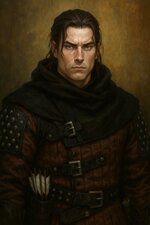
Kael’rin was born on the edge of Mistledale, where the farmlands of men give way to the deep green reaches of Cormanthor Forest. His father, Elman Oakshadow, was a Dalelands ranger by trade and by calling — Oakshadow not a true surname, but a name earned through long years patrolling the forest’s edge. His mother, Amakiir, was an elven woman of the woods who had chosen a life apart from her people to walk beside Elman.
Together they raised Kael’rin between two worlds. From Elman came vigilance, self-reliance, and the quiet understanding that the wild must be guarded, not ruled. From Amakiir came patience, attentiveness, and respect for the forest as a living thing rather than a boundary to be defended. Though Amakiir remained true to the Seldarine, she did not object when Elman brought their son into the gentle teachings of Mielikki, believing there was wisdom in allowing Kael’rin to find his own path. She spoke often of one day taking him deeper into Cormanthor to meet her kin, once he was old enough to understand both what he was and what he was not.
For a time, life was good. The Dales prospered during the Longest Year, even as magic waned elsewhere. Trade flourished, old rivalries softened, and talk of unity spread among the towns. Kael’rin’s childhood was marked by simple things — lessons beneath the trees, long walks along the forest’s edge, and nights spent listening to stories by firelight.
That peace ended in 1368 DR, with the event later known as The Night of Black Knives.
Drow forces erupted from below the southern Dales under cover of darkness, overwhelming Scardale, Featherdale, Tasseldale, Deepingdale, and Archendale in swift succession. Refugees fled north as rivers became warfronts and the Dalelands were thrown into chaos. Mistledale and the northern Dales braced themselves as the elves of Cormanthor joined Dalelands forces to stem the advance.
Kael’rin was sixteen when the fighting reached the forest’s edge. Though old enough to understand what was happening, he was forbidden to fight. Elman would not risk his son’s life, not yet. Amakiir, however, believed it her duty to defend the forest she loved — not as an elf of a distant people, but as a guardian of the land itself.
She never returned.
She fell beneath the trees she had sworn to protect, struck down by black-fletched bolts as the drow pressed northward. Those who found her later spoke of mockery in a dark tongue as she died — a word for traitor — though Kael’rin would not hear that word until much later.
Elman fought on, hardened by grief and driven by resolve rather than rage. For two more years he patrolled the borders, escorting refugees and caravans through increasingly dangerous roads. His end came defending a caravan along the Ashaba, killed in another drow raid while buying time for others to escape.
Kael’rin buried his father beside the remains of their old home, the forest close and silent around him. In that moment, Mistledale no longer felt like home — only a place filled with echoes.
At eighteen, he left the Dalelands, traveling south through the Heartlands until he reached Murann in Amn. He did not seek vengeance, nor glory. He sought distance, hoping that time and road might dull memories that refused to fade. Murann offered noise, movement, and the illusion of peace — a city of stone and sea far removed from shadowed trees and war-torn borders.
Yet even there, the pull of the wild never left him.
Kael’rin spent a short time in Murann, but the city never truly sat well with him. Stone and sea could not quiet the pull of the wild, nor ease the weight he carried. In time, his wandering steps led him north and east again, to the Wealdath. There, he found the Circle of druids known as the Conclave.
Among them, he was no immediate welcome — trust had to be earned, skill proven, and intent made clear. Kael’rin endured the tests set before him, learning not only how to defend the forest, but how to listen to it. In the deep green of the Wealdath, he found something he had not expected: a sense of belonging. Guarding the ancient woods became more than duty; it became a way to honor both the ranger who taught him vigilance and the elf who taught him reverence for the living land.
Beneath it all, Kael’rin searches for understanding — of his elven heritage, of the paths his parents walked, and of where he truly belongs between forest and field, faith and blood. He carries both legacies with him now, not as burdens, but as quiet promises yet to be fulfilled.
Last edited:
