


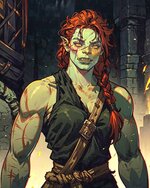
Upon the eve of a hunt was Saskia Stoneblood conceived - born to the warrior-hunters of The Monolith That Listens, who rode from the plains of Anauroch down to Sembia atop great, enthralled beasts in search of worthy foes to prey upon. Unlike their more wild and errant cousins, the small clan saw no glories worth a trophy in the tame and civilized lands most orcs would raid and pillage. Their currency was the saga of deeds done - the song of a headtaking, and the bloodied story retold. Those few that dared associate with them considered them a hammer that could be directed towards stubborn problems at best. To others, they were akin to a tornado raging through a valley; an unruly violence but restricted to somewhere distant and more deserving.
It was enough of a compromise between danger and cooperation for the men of the Dales, who developed a clever scheme as the hunting-clan sought passage through their lands while trailing a pack of dire badgers. Rather than provoke the orcish tribe, they offered a union of friendship that would see them gone without bloodshed and their hunt continued. The ceremony changed in scope, somewhat, from a mere feast, to one of marriage - though there is speculation this was pushed by some of the locals to drive the Damaran stonemason Emory Stoneblood off. Despite the Dale's roots, many locals had little patience for who is a foreigner in their lifetime.
To the orc clan, the affair was a trivial setback on time alone. Their hunt took them around Deepingdale, and if the mewling locals desired to offer up their food and drink as tribute for their hunt, it was nothing to give one of their women for a night to complete the ceremony.
It was during the revelry that the deceptive men of the Dales sprung their trap. The hunters were imbibed with a bounty of meat and fruits. They became drunk on the sweetest of meads, dimming their senses and drawing their guard down. Then, when their minds were found alarmingly open, they were granted demonstrations with agricultural implementations assuredly laced with the most vile of thought-curses. The once proud slayers of The Monolith That Listens had their minds forever supplanted by the Planter's Curse. The first song whose echo could be traced back hundreds of years was now doomed to end as the men of the clan awoke not with the desire to continue their hunt, but to toil with full bellies on their hands and knees, planting seeds forevermore.
Saskia would be the last child born of that lineage, her mother leaving her in the care of her father whenever she left the Dalelands. The women of the clan were strangely unaffected by the Planter's Curse, and for this they took up axe and arms to roam the world in search of what little glory could be drawn from it before their inevitable demise. The men of the clan became a band of dispersed farmers living in isolation across the forests near Deepingdale, minds rooted to the ground as assuredly as the seeds they had sown. To this day, they produce a small but pleasant harvest of sunmelons - ignorant of their disgrace.
While Saskia grew, she lived split between two starkly different worlds.
Her father plied a successful trade. While some were speculative of his sincerity, none could doubt the quality of his craft, and so his half-blood daughter was raised relatively comfortably. No stranger to discrimination, her father imparted the value of wit and language onto Saskia, insisting that others would respect her intelligence and her words if not her complexion.
But Emory Stoneblood's opposition in this tutelage was Muzana Oduara Kinthrenody. Despite being absent for the first six years of Saskia's childhood, she spent that time shaping the fourteen warrior-women of The Monolith That Listens into a blade so sharp it sang through the air once again. The titles she had accumulated were great, becoming known in the area as the Slayer-Queen of Sembia, Badger-Breaker, and Grog-Herder. Granted the panoply of the Song-Chief, she wore the cloak called the Screaming Mantle, and wielded the Calimsharan Axe of Kin'sha'ira in resplendence.
Mayors and lowly barons would hire envoys in secret to request the aid of these savage orc women to dispatch of both wild and fey creatures that prowled their lands, and they amassed many trophies at the foot of the Walking Hearth - the monolithic conduit to their savage God staked into the shell of the dire turtle, Duganza. For all of Emory's rustic wisdom, he could not compare to the living tempest. No amount of time in the world could have dimmed the stars in Saskia's eyes whenever she looked upon these warrior-women of the clan, or heard the tales of the glories of now and in past. She may have only seen her mother once or twice each year, but whether it be for a week or a month - the impression was always severe.
Raised upon the stories of impossible conquests whose truths she never questioned, Saskia truly believed her clan to be the blood of dragon and godslayers, and set lofty goals accordingly. If her ancestors could supposedly place the trophies of mythical foes at the foot of the Walking Hearth atop Duganza's shell, so would she. If the vestiges of The Monolith That Listens would live out the rest of their days in search of a beautiful end befitting such a legacy so, too, would she.
While her father could not compare as a role model, there were some compromises he could make with his daughter that Muzana did not argue with - mainly due to absence. Saskia would be educated as well as she could be, and learn the local languages - as well as that of her father's people. He also impressed a desire to worship the human pantheon - to which Muzana didn't so much agree to, as much as fail to impart the values of worship in He Who Watches. While Saskia was capable of the rituals and customs asked of her when with the clan, they didn't have nearly the same aptitude nor time for teaching the importance of them. Meanwhile, Emory Stoneblood was glad to take his roughhousing daughter to the warrior-barracks of the Foehammer if it meant one more inch towards normalcy.
Lastly, Saskia would take her father's surname - a stain that she bears with the weight of a curse. In the clan's custom, every name was the herald to a story and a deed done, and thus were only born with the one name given by the Song-Chief. For Saskia to be given this surname by her father would grant her greatest act to being born the daughter of a stonemason - a wholesome possibility rejected as the delusional desires of a prosaic father.
Once the fiery half-orc girl blossomed into a yearning warrior, she stole her father's woodsplitting axe and took to the roads in search of conflicts to temper her skills upon. She initially joined a ship of mercenaries bound to join a conflict against the Red Wizards of Thay while their magic had abandoned them, but was turned around by an unfortunate wind. After a brief chastisement at home, she set off once again, but this time north towards Damara after catching rumors of conflicts brewing. This time, Saskia did arrive at her destination - but days late, the battle she hoped for already reduced to pockets of skirmishes amongst a rout. It was here, in the dust, Saskia slew her first opponent. A captain - or perhaps another lesser warleader of the defeated army - left wounded with his bodyguard lain about him in a final display of their martial loyalty. In his last, lucid moments before his guard dropped, and the axe fell, he thought he saw his granddaughter. To his killer, he was simply an old, feral dog - the best of its battles long behind it.
Per the many superstitions of her strange clan, age was an inevitable body-curse that could only be avoided in death, lest it diminish its host of their strength, courage, and most of all - their capacity for glory. What should have been a noble triumph was hollowed, and Saskia bears a timid spite towards the Curse of Age since that day; afraid of its capacity to rob both her foes and herself of their greatest worth.
As she left Damara for the south-west, her dreams became clouded by a bloody-red canvas displayed atop a mountain of bones - the imagery the history of her clan, writ across time in strokes of crimson. Each night, the lightning-crack of a storm overhead illuminates her hand wielding the brush, anxiously deciding the next, careful daub or swipe. Stirred on by these dreams, they have pushed her towards each hunt after each hunt, searching for another fitting skull to add to her ancestors mountain before her timely end marked the finale of the composition.
After five summers of traveling the world in search of such prizes - spending the winters at home with her father or the diminishing remains of her clan - she has had little success in attaining anything more than bruises, scars, and the stories of better warriors. Reaching full maturity, she's grown into becoming a broad-shouldered, tall woman with distinct blood-red red hair. While the victories of her youth have been few and far between, her body has been shaped by rigurous exercise into peak physical condition.
Saskia's lone doom-march now brings her to Amn and Tethyr - a land ripe for fell deeds worthy of both songs to return to the Walking Hearth, and another stroke on the canvas that will forever be The Monolith That Listens.
Last edited:
