


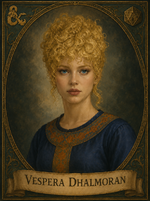
Born in the waning comfort of a lesser Amnian household whose fortunes had long since begun to thin before anyone dared admit it aloud. The Dhalmorans were neither destitute nor truly influential, one of those middling families that survived through careful marriages, measured speech, and the stubborn preservation of appearances. Their home stood not amongst Athkatla's great marble estates, but within the respectable districts where merchants, minor functionaries, scribes, and educated widows attempted to imitate the manners of greater blood with varying success.
Her father dealt in ink, parchment, and imported texts, a profession that carried far more prestige in conversation than profit in truth. Her mother had once belonged to a family of provincial notaries near Purskul and possessed a sharp tongue moderated only by strict etiquette. From an early age, Vespera was taught that dignity was not inherited through wealth alone, but performed. One's posture at table mattered. The choice of words mattered. The cut of sleeves, the quality of paper, the ability to recognize a noble crest or quote a poet, all mattered. Especially in Amn.
Unlike many girls her age, Vespera learned her letters early and eagerly. By adolescence she had consumed every travelogue, account, sailor's memoir, religious dissertation, and half-rotted chronicle her father could acquire. She developed a particular fascination for contradictions in people and nations alike, how merchants prayed for virtue while funding pirates, how priests preached humility from gilded halls, how adventurers became heroes merely because they survived long enough for someone to write kindly of them.
She write often. At first, they were harmless observations copied into cheap journals, the smell of wet docks at dawn, the mannerisms of caravan guards, the sounds of rain against tiled roofs in Athkatla. Later came essays and serialized tales distributed in small literary circles and copied by hired scribes for coin. Her writings were never famous, though they traveled further than she did. A merchant from Crimmor once commissioned a short account from her regarding the River Esmel and claimed her words sold more river journeys than his barges ever could. Another patron praised her uncanny ability to make common laborers sound dignified and nobles quietly pathetic without ever directly insulting either.
For a brief period, it seemed her life might become a comfortable one. Then came the years that broke Amn.
The stories arrived first.
Rumors of unrest. Missing caravans. Rising prices. Strange movements near the Small Teeth. The sort of distant anxieties respectable households dismissed over supper wine and candlelight. Athkatla had endured troubles before. Great cities always did. Then the roads stopped speaking.
The Winter of Teeth swept across western Amn like a butcher's blade. Refugees flooded eastward with impossible tales, burned settlements, shattered forts, ogres marching beneath banners, entire roads swallowed by warbands. Trade collapsed into panic. Merchants hoarded grain. Families vanished overnight. In the streets of Athkatla, dignity dissolved faster than law itself. Vespera witnessed what became of civilization when fear outweighed order.
The city that had once debated tariffs and poetry descended into bloodied desperation. Nobles fled with hired blades at their backs. Wagons overturned in the streets beneath the weight of stolen goods. Men killed neighbors for horses. Entire districts became ruled by whichever armed group reached them first. The proud jewel of Amn rotted from within before the Horde ever truly claimed it.
The Dhalmorans did not survive those days unchanged.
Whether through debt, violence, disappearance, or simple ruin, little remained by the end besides Vespera herself and what belongings she could carry away. She left Athkatla not as a refugee in chains and tatters, but as one of countless displaced souls attempting to preserve the illusion of composure while the world beneath their feet collapsed.
She traveled south and west with merchants, pilgrims, deserters, widows, laborers, and liars. Some stretches of road were quiet enough for birdsong. Others stank of corpses left beside broken carts. Everywhere, the same unease lingered, the old world had ended, and nobody yet understood what the new one would become.
Murann greeted her not with opportunity, but with exhaustion.
The Sailor's City had swollen beyond comfort beneath the weight of war and displacement. Refugees slept beneath awnings and warehouse roofs. Harbor guards watched crowds with hands near sword hilts. Foreign tongues mixed with Chondathan curses in markets where food prices shifted by the day. Sailors, privateers, laborers, mercenaries, hedge scholars, ruined merchants and opportunists all crowded the same narrow streets. And yet, amidst the tension and smoke, Murann lived.
Unlike Athkatla, Murann had not yet surrendered to despair.
The city breathed in a harsher rhythm now, suspicious, overcrowded, hungry, but alive. Ships still came and went. Taverns still argued deep into the night. Markets still functioned beneath the shadow of war. Men and women still dreamed of becoming more than what the age had made them.
So too did Vespera.
Now counted amongst Murann's common folk, she survives through writing, correspondence, copying texts, and whatever honest work educated hands may still find in troubled times. Some know her as a quiet young woman often seen with ink-stained fingers and weather-damaged journals. Others know her as someone unusually attentive during conversation, as though every word spoken around her might someday find itself preserved upon a page. She listens more than she speaks. She walks the harbor often.
And somewhere beneath the weight of collapsing kingdoms, frightened gods, ruined cities, and uncertain tomorrows, Vespera Dhalmoran continues to write.
Perhaps because she fears the world will forget itself if nobody does.